In the past 24 hours, cutting edge AI news has centered on AI frontier developments 2026, with a clear emphasis on agentic systems and collaborative frameworks rather than flashy new foundation model drops. While major new AI model releases were limited in volume during this window, the latest AI breakthroughs in research and technical architecture signal strong momentum in frontier AI models and AI technology innovations. These advancements focus on autonomous reasoning, multi-agent collaboration, and multimodal efficiency—areas with immense development prospects for transforming complex workflows, scientific discovery, and real-world task execution. As AI advancements accelerate toward more capable, goal-directed intelligence, the implications for high-impact applications in coding, research, and enterprise automation are profound.
Agentic AI: The Next Major Shift in Latest AI Breakthroughs
A timely analysis published within the past 24 hours underscores that the true frontier in AI technology innovations lies not in generating more content, but in building agentic AI systems capable of planning, acting, observing outcomes, and adapting in dynamic environments. Unlike traditional generative models focused on output creation, these agentic frameworks prioritize autonomous execution of multi-step tasks with minimal human oversight, integrating seamlessly into real-world workflows such as software development lifecycles and business operations.
This evolution addresses key limitations in current generative AI by emphasizing verifiable results, risk assessment, and iterative improvement. Organizations are already experimenting with agentic setups in 62% of cases, according to recent insights, shifting productivity metrics from speed alone to intelligence-driven quality and adaptability.
Development prospects look promising: agentic AI could orchestrate entire toolchains, enabling humans to command high-level outcomes while AI handles execution details. Future implications include reduced production incidents (currently affecting 72% of AI-generated code deployments in some reports), enhanced business resilience through continuous risk foresight, and scalable automation that maintains trust via human-AI collaboration. As part of broader AI frontier developments 2026, this positions agentic systems as a cornerstone for reliable, high-impact AI advancements.
Source: The Next AI Breakthrough Isn’t Generative, It’s Agentic from DevOps.com
Recursive Multi-Agent Systems (RecursiveMAS): Scaling Collaboration in Frontier AI Models
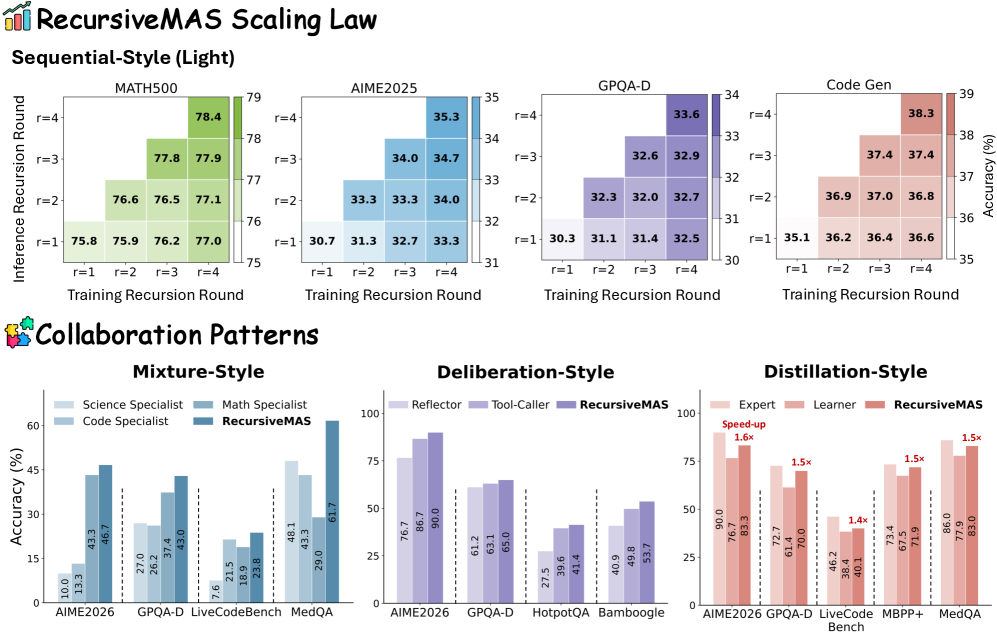
One of the most technically significant latest AI breakthroughs from the past 24 hours comes via arXiv, with the submission of “Recursive Multi-Agent Systems.” This new framework extends recursive scaling principles—previously applied to single models for deeper reasoning—to entire multi-agent setups. RecursiveMAS treats the full system as a unified latent-space computation loop, using a lightweight RecursiveLink module to connect heterogeneous agents for in-distribution latent thoughts and cross-agent state transfer.
An inner-outer loop learning algorithm enables iterative co-optimization across recursion rounds with shared gradient credit assignment. Theoretical analysis confirms lower runtime complexity than standard text-based multi-agent systems, stable training gradients, and practical efficiency gains: 1.2×–2.4× faster end-to-end inference and 34.6%–75.6% token reduction.
Tested across four collaboration patterns and nine benchmarks spanning mathematics, science, medicine, search, and code generation, RecursiveMAS delivered an average 8.3% accuracy boost over advanced single- and multi-agent baselines.
Development prospects are excellent for frontier AI models, as this approach makes deep, collaborative reasoning scalable and cost-effective. Future implications include accelerated progress in agentic AI for interdisciplinary tasks, from drug discovery to complex software engineering, potentially compressing timelines in research and enterprise applications while maintaining robustness.
Source: Recursive Multi-Agent Systems (arXiv:2604.25917) submitted April 28, 2026
NVIDIA Nemotron 3 Nano Omni: Open Multimodal Model Boosts Agentic Efficiency
Recent discussions and technical releases in the past day highlight NVIDIA’s Nemotron 3 Nano Omni as a cutting-edge AI advancement tailored for frontier agentic workflows. This 30B-parameter (3B active via MoE) open-weights multimodal model processes video, audio, images, and text in a single efficient pass, achieving up to 9× faster and cheaper operation compared to separate modality pipelines.
With a 256K context window and compatibility across NVIDIA hardware from Ampere to Blackwell, it serves as an ideal perception layer for agentic AI—feeding structured multimodal context to higher-level reasoning models without API lock-in.
This open-source innovation aligns perfectly with AI frontier developments 2026, lowering barriers for building robust multimodal agents in robotics, real-time monitoring, and interactive systems.
Development prospects include rapid adoption in production agent stacks, where efficiency and openness accelerate iteration. Future implications point to more capable, cost-effective AI technology innovations that bridge perception and action, enabling truly autonomous agents in physical and digital environments.
Source: NVIDIA Technical Blog and frontier AI community discussions on April 28-29, 2026
Hierarchical Agents and Agentic World Modeling: Emerging Frameworks for Reliable Autonomy
Additional research momentum in the past 24 hours includes advancements in hierarchical agent training (such as HyperAgent systems) and comprehensive surveys on agentic world modeling. HyperAgent introduces nested “manager + specialist” hierarchies where a top-level agent decomposes tasks and delegates to specialized sub-agents, yielding up to 3× performance gains on complex multi-step benchmarks.
Complementing this, agentic world modeling frameworks organize predictors, simulators, and evolvers across physical, digital, social, and scientific domains—providing structured taxonomies for evaluating and building environments that agents can reliably navigate.
These AI technology innovations address core challenges in frontier AI models: scalable delegation, persistent memory, and accurate world representation for safe, long-horizon planning.
Development prospects favor enterprise-grade deployments, where hierarchical designs ensure reliability and world models enable robust generalization. Future implications are transformative, paving the way for production-ready agentic AI that compresses timelines in knowledge work, robotics, and scientific research while incorporating governance for viability and safety.

Source: HyperAgent research and Agentic World Modeling survey discussions from April 28, 2026 X posts and related technical sources
Broader Implications for AI Advancements in 2026
These developments collectively reinforce the trajectory of cutting edge AI news toward agentic, collaborative, and efficient systems. With strong development prospects for reduced compute costs, higher accuracy in real-world tasks, and scalable autonomy, the coming months could see these innovations integrate into mainstream tools—driving new AI model releases and AI frontier developments 2026 that prioritize impact over raw scale. The focus on open frameworks and research efficiency bodes well for democratized access to frontier AI models, fostering broader AI advancements across sectors.
Stay tuned for more daily cutting-edge AI updates. The images used in this article are sourced from publicly available channels on the internet. They are used solely for the purposes of news commentary, visual illustration, and explanatory reference, and do not constitute commercial use. The author of this article does not own the copyright to these images and makes no claim to any rights over them. If any copyright issues arise regarding these images, please contact the article’s author, and we will promptly address the matter or remove the relevant content.