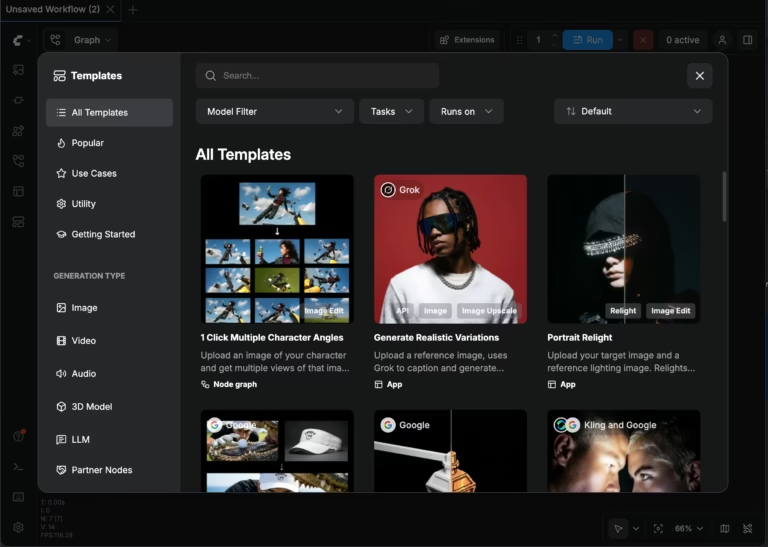
ComfyUI workflow update May 2026 continues the platform’s rapid evolution toward more robust multi-modal and video pipelines. In the past 48 hours, core repository activity focused on video model integrations, subtle but impactful frontend polishing, and backend fixes that address latent handling and subgraph stability. These changes reflect an ecosystem shifting toward production-ready video workflows while mitigating fragmentation risks from frequent frontend iterations.
Introduction
The ComfyUI ecosystem in early May 2026 shows steady refinement rather than explosive new model drops. Developers prioritized compatibility for emerging video architectures like Wan variants and LTX refinements, alongside frontend reliability. This matters for users running complex batch video or hybrid image-to-video chains, where even small tensor mismatches or UI drag behaviors can cascade into hours of debugging.
ComfyUI current version May 2026 users will notice improved handling of guide images, inplace operations, and subgraph widget persistence. These aren’t headline features but directly influence workflow portability and VRAM predictability on mid-to-high-end GPUs. Custom node authors and heavy video users should pay closest attention.
Major Updates
Wan-Dancer and Video Model Support Expansions
What changed: Core commits added explicit support for Wan-Dancer alongside LTX-related fixes (e.g., preventing inplace mutation of input latents in LTXVImgToVideoInplace and centering guide images for consistency).
What problem does this solve? Previous Wan implementations suffered from inconsistent guide image cropping and latent mutation side-effects that corrupted multi-step video pipelines or caused unexpected noise_mask drops.
Who should care? Video workflow architects using Wan 2.x series, LTX variants, or hybrid I2V setups—especially those chaining causal forcing models or temporal downscaling.
Workflow impact: Video chains now maintain cleaner latent states across nodes. This makes longer context window blending and guide-conditioned generation more reliable without manual tensor fixes or extra preprocessing nodes. Batch video processing becomes less prone to silent failures.
Technical explanation: The fixes target tensor device alignment, inplace operation safety, and aspect ratio handling in partner nodes. For instance, LTXV nodes now center-crop guides to match downstream expectations, reducing dimension mismatches that previously triggered SamplerCustomAdvanced crashes.
Risk / limitation / compatibility issue: Older custom nodes relying on mutating latents may break or produce different outputs. Subgraph users with promoted widgets could see persistence quirks until frontend fully syncs. VRAM implications remain neutral-to-positive as cleaner operations reduce unnecessary reallocations, but test on your exact GPU (especially Blackwell 50-series with cu128).
Actionable tip: Update core + frontend package, then reload Wan/LTX workflows. Add explicit LatentCutToBatch nodes where batch splitting was previously implicit for stability.
Caption: ComfyUI Wan-Dancer video workflow node graph showing guide image centering and latent safety improvements.
Frontend v1.45.1 / v1.45.2 Polishes and Stability Tweaks
What changed: Rapid frontend releases addressed painter responsiveness, dialog migrations to Reka-UI, asset filename stripping, subgraph drag prevention, and various 3D/load persistence fixes. Asset pagination and search ranking tweaks (e.g., boosting SaveImageAdvanced) also landed.
What problem does this solve? Recent frontend iterations introduced layout glitches, unsaved-changes modal confusion, drag-induced subgraph entry errors, and thumbnail/overlay inconsistencies—frustrating daily node manipulation.
Who should care? All users, but especially those with large node graphs, subgraphs, 3D previews, or heavy asset browser usage.
Workflow impact: Smoother dragging, resizing, and tab switching reduce accidental subgraph entries or lost camera states in Load3D nodes. This directly improves iteration speed in complex multi-modal workflows.
Technical explanation: Changes include responsive label handling in painters, guard rails against re-initialization, memoization for asset transforms, and better event handling to prevent enter/toggle during drags. These are low-level React/Vue alignment fixes that stabilize the graph canvas without altering core execution.
Risk / limitation / compatibility issue: Frequent frontend bumps can temporarily desync with certain custom nodes (classic Manager warning). Some Reka-UI dialog migrations are phased, so visual inconsistencies may persist briefly. Performance on lower-end machines benefits from memoization but test thoroughly.
Actionable tip: After updating, clear browser cache or restart ComfyUI. Use the new search ranking boost by favoring SaveImageAdvanced in templates for faster discovery.
Caption: Updated ComfyUI frontend May 2026 interface with improved painter and subgraph handling for stable video workflows.
Manager DB Refresh and Minor Core Housekeeping
What changed: ComfyUI-Manager received a routine node DB update on May 8. Core added .comfy_environment to portable, workflow template bumps, and small partner node expansions (Tripo3D, Grok Imagine).
Workflow impact: Easier discovery of new utility nodes without manual Git clones. Portable installs gain better environment isolation, reducing cross-contamination in multi-project setups.
VRAM / speed implication: Indirect—cleaner environment handling and throttled dynamic VRAM logging (from slightly earlier commits) minimize background overhead during long runs.
Practical Takeaways for Users
- What to update: Pull latest ComfyUI core, comfyui-frontend-package (target v1.45.2+), and run Manager DB refresh. Update video-specific custom nodes for Wan/LTX compatibility.
- What to avoid: Blind-updating massive custom node packs without testing—frontend changes have broken Impact Pack or similar in the past. Skip if running mission-critical stable workflows.
- What to test: Reload existing Wan or LTX video pipelines; check subgraph widget persistence and guide image behavior. Benchmark a batch I2V run for latent stability and VRAM peaks.
- What is still unstable: Phased Reka-UI dialogs and any remaining 50-series Blackwell edge cases with older PyTorch builds. Dynamic VRAM continues maturing but monitor logs on WSL.
ComfyUI workflow update May 2026 pushes video reliability forward while sanding down UI friction. Expect continued focus on multi-modal stability as video models proliferate.
Caption: Practical ComfyUI May 2026 takeaways workflow screenshot highlighting key nodes for video pipeline testing.
Sources
- Comfy-Org/ComfyUI GitHub commits and releases
- Comfy-Org/ComfyUI_frontend releases (v1.45.x)
- ComfyUI-Manager node DB updates
Disclaimer
The images used in this article are sourced from publicly available channels on the internet. They are used solely for the purposes of news commentary, visual illustration, and explanatory reference, and do not constitute commercial use. The author of this article does not own the copyright to these images and makes no claim to any rights over them. If any copyright issues arise regarding these images, please contact the article’s author, and we will promptly address the matter or remove the relevant content.