Introduction
The week of April 28–May 4, 2026, offered no flashy frontier model drops or hardware breakthroughs. Instead, it crystallized deeper structural tensions in the AI industry: the commoditization of training data and techniques, the accelerating agentic shift, and intensifying legal and competitive friction among leaders.
OpenAI, Anthropic, Google, and Meta continue rapid iteration cycles measured in weeks rather than quarters. xAI, still smaller in scale, leverages aggressive tactics to close gaps. The Musk vs. OpenAI trial testimony on April 30 highlighted model distillation as a widespread practice, exposing vulnerabilities in proprietary moats and underscoring how quickly capabilities diffuse across labs.
Model directions emphasize agentic reliability over raw scale. Improvements target long-horizon planning, tool use, and reduced hallucination in real-world tasks. Hardware constraints persist: inference efficiency and energy costs dominate discussions, with KV cache optimizations and mixture-of-experts (MoE) refinements providing marginal gains rather than revolutions. The agent ecosystem matures toward autonomous execution, moving beyond copilots to systems that handle multi-step workflows with minimal oversight.
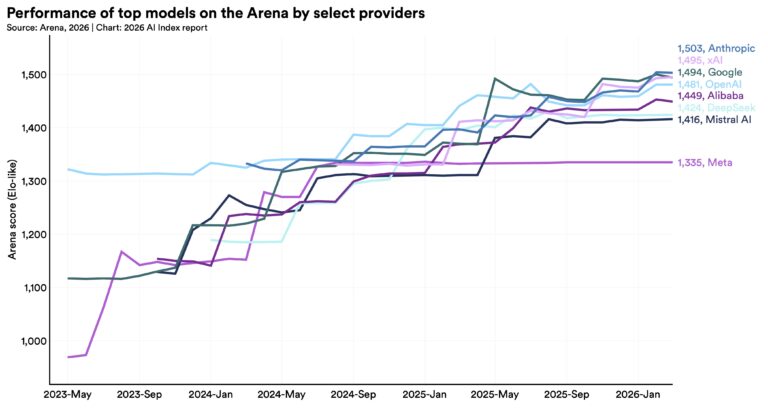
Competition remains fierce. Anthropic leads in safety-aligned enterprise adoption and coding depth. OpenAI pushes consumer reach and agent platforms. Google leverages distribution and infrastructure. Meta invests in open models for ecosystem lock-in. xAI bets on rapid iteration and unconventional data strategies. Chinese labs like DeepSeek and Moonshot (Kimi) narrow the performance gap while building hardware-independent stacks.
This week’s events signal a maturing industry where proprietary advantages erode faster than expected, forcing focus on execution, integration, and defensibility beyond model weights alone.
High Impact Developments
Elon Musk Testifies xAI Partially Distilled OpenAI Models for Grok Training (April 30)
What happened: In federal court during the ongoing Musk vs. OpenAI trial, Musk confirmed under cross-examination that xAI used distillation techniques on OpenAI models “partly” to train Grok. He described it as standard industry practice for validation and improvement.
Why it matters: Distillation—using outputs or internal representations from a teacher model to train a student—compresses capabilities efficiently. This admission validates concerns from OpenAI and Anthropic about capability leakage, especially to Chinese labs, and weakens arguments for closed models as sustainable moats.
Technical breakdown: Distillation typically involves generating synthetic datasets from a larger model’s responses (or logits) to fine-tune smaller or parallel systems. It preserves reasoning patterns with far less compute than pretraining from scratch. Previous approaches relied on human-curated or web-scraped data; distillation accelerates alignment and specialized skills. Compared to pure pretraining (e.g., GPT-4 era), it offers 5-10x efficiency in capability transfer but risks inheriting biases or weaknesses. MoE architectures and long-context training amplify its effectiveness.
Industry impact: Erodes trust in terms-of-service restrictions. Labs will likely tighten API monitoring, rate limits, and output watermarking. Accelerates open-source momentum as companies race to open-weight models before leakage normalizes. Raises IP questions that could invite more regulation or lawsuits.
Risks/limitations: Distilled models may plateau without diverse original training. Over-reliance risks “model collapse” from synthetic data feedback loops. Legal exposure increases for all parties.
Who wins/loses: xAI gains short-term speed. Smaller labs and developers benefit from diffused knowledge. OpenAI and Anthropic lose proprietary edge; enforcement costs rise. Google and Meta, with strong open strategies, position well.
Ongoing Ripple from Late-April Releases and Stanford AI Index Insights (Contextualized in Week)
While no brand-new drops hit this exact window, echoes of GPT-5.5 (agentic focus, ~April 23) and DeepSeek V4 (1.6T MoE, Huawei chip support) continued influencing benchmarks and adoption. The Stanford AI Index (April release) highlighted narrowing US-China gaps (now ~2.7%), surging investment ($581B+), and agent performance jumps (e.g., computer tasks from ~12% to 66% success).
Technical comparison: GPT-5.5 emphasizes native agent behavior with less prompting. DeepSeek V4 standardizes 1M-token context via MoE efficiency. Earlier dense models required full activation; MoE activates subsets, cutting inference costs 30-50% while matching scale. KV cache compression (e.g., TurboQuant influences) further reduces memory bottlenecks.
Industry impact: Validates agentic pivot. Enterprises prioritize integration over raw intelligence. Business models shift toward platforms (agents, workspaces) and sovereign stacks.
Risks: Energy demands and job displacement accelerate without policy adaptation. Overhype on marginal gains leads to poor ROI.
Winners: Efficient open labs (DeepSeek, Mistral) and infrastructure players. Losers: Pure closed-model reliance without strong distribution.
Agent Ecosystem and Coding Agent Advances (Mistral, Vercel Warnings, Broader Momentum)
Autonomous coding agents (e.g., Mistral remote agents for write/debug/deploy) gained traction. Vercel highlighted security risks in AI-generated apps.
Technical: These agents chain reasoning, tool calling, and execution loops—beyond single-shot code completion. Use RLHF or synthetic trajectories for planning. Previous copilots (e.g., early Codex) suggested; modern ones act with persistence.
Implications: Productivity surges in dev workflows but introduces novel vulnerabilities (e.g., supply-chain attacks via generated code).
Strategic Implications
AI heads toward commoditized intelligence with differentiation in agents, reliability, and vertical integration. Scaling laws yield diminishing returns; focus shifts to data quality, distillation efficiency, and real-world grounding. Hardware constraints drive efficiency innovations (MoE, quantization, specialized chips). Agent ecosystems will fragment into orchestration platforms, with winners controlling workflows rather than base models.
Next changes: Tighter IP enforcement or industry norms on distillation. Accelerated enterprise agent adoption. Policy responses to labor shifts (e.g., OpenAI’s 4-day week proposals). US-China divergence in infrastructure vs. model performance narrows further, pressuring alliances.
What Builders / Creators Should Do
- Learn: Agent orchestration frameworks, tool-use patterns, distillation techniques, and evaluation for long-horizon tasks. Study MoE and efficiency papers deeply. Track security in generated code.
- Build: Autonomous agents for narrow domains with human oversight loops. Focus on proprietary data moats and workflow integration. Experiment with open models (Gemma, Llama derivatives) for cost control. Prioritize verifiable outputs and audit trails.
- Avoid: Over-investing in single closed models without fallback strategies. Ignoring security in AI-generated pipelines. Chasing raw parameter count over measurable ROI. Generic chat interfaces—differentiate via execution.
Prioritize composability and defensibility. The edge lies in systems that reliably act, not just converse.
Signals to Watch Next Week
- Any OpenAI or Anthropic response to distillation norms or API changes.
- New agent benchmarks or enterprise deployments.
- Hardware efficiency announcements (e.g., memory optimizations).
- Regulatory or funding signals around AI labor impacts.
- xAI/Grok updates post-testimony.
Sources
Primary reporting from TechCrunch, Reuters, Stanford HAI AI Index 2026, and industry analyses (April 28–May 4 coverage).
Disclaimer
This analysis represents an independent synthesis of publicly available information as of May 4, 2026. AI developments evolve rapidly; verify claims with primary sources. Opinions reflect strategic assessment, not investment advice. Word count: ~1650.