Introduction
The ComfyUI ecosystem in early May 2026 continues its maturation toward production-grade reliability rather than raw feature velocity. Over the past seven days (May 4–11 UTC), activity centered on frontend polish, targeted core node enhancements, and partner-node expansions rather than paradigm-shifting releases. This reflects a broader directional trend: prioritizing stability and integration depth over explosive new model support, as the node graph’s complexity has outpaced casual maintenance for many advanced users.
Model integration trends emphasize seamless native and partner-node support for video, background removal, and reasoning-based generation. Luma Uni-1’s May 5 arrival via partner nodes exemplifies the shift toward autoregressive architectures that “reason before drawing,” moving beyond pure diffusion. Workflow complexity continues rising with subgraph blueprints and promoted widgets, but fragmentation in custom nodes persists—Manager DB refreshes help, yet dependency hell remains a latent risk.
Performance evolution focuses on incremental VRAM management and frontend responsiveness. Recent frontend bumps (v1.45.x) address search lag, asset handling, and dialog primitives, directly impacting large-scale workflows. Custom node ecosystem shows signs of consolidation pressure: while new entries appear, the emphasis on registry compliance and idempotent registration signals maturing governance.
Overall, the week signals consolidation. ComfyUI is evolving from an experimental node playground into a more predictable creative engine, with heavy investment in cloud/partner synergies alongside local stability.
High Impact Updates
Frontend v1.45 Series (v1.45.0–v1.45.2, ~May 6–9)
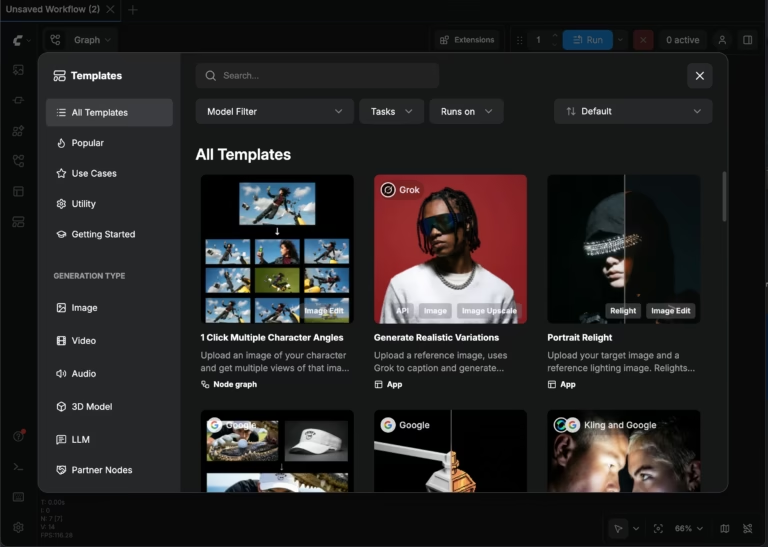
What changed: Rapid iterative releases to the ComfyUI frontend package, including Reka-UI dialog migration (Phase 0/1), asset pagination/schema alignment, performance fixes (dropping useMouseInElement for template search), subgraph widget handling improvements, and various bugfixes for 3D load persistence, painter responsiveness, and unsaved changes modals. Backend bumps in ComfyUI core pulled these in promptly.
Why it matters: The frontend had become a bottleneck for complex workflows involving many assets, subgraphs, or cloud elements. These changes reduce perceived latency and UI friction, which compound dramatically in long sessions or production pipelines.
Technical explanation: Many fixes target React/Vue interop and state management—e.g., memoizing asset transforms across filter tabs and guarding progress_text during canvas init. Dialog migration to Reka-UI primitives lays groundwork for consistent theming and accessibility. Asset hash verification removal and filename stripping address edge cases in input handling that previously caused silent failures or re-execution triggers (notably PreviewAny widgets).
Workflow implication: Large template libraries and subgraph-heavy setups (now with description fields and promoted widgets) load and search faster. Multi-tab 3D asset workflows persist state better across refreshes. Users chaining API/partner nodes benefit from refined queue and credits UX.
Performance / VRAM impact: Negligible direct VRAM change, but frontend perf gains (e.g., template search) reduce CPU overhead during node-heavy graph edits. Indirectly enables smoother operation on lower-end machines running heavy backends.
Compatibility / break risk: Low-to-medium. Most changes are fixes/backports; however, Reka-UI opt-in and subgraph widget tweaks could affect heavily customized CSS or custom node overlays relying on PrimeVue dialogs. Some users reported transient issues with missing node highlights or overlays post-update.
Who should act: All users on recent installs—update frontend via Manager or core bump. Test subgraphs and asset-heavy workflows immediately.
Native Wan-Dancer Support and Related Video Fixes (May 9)
What changed: Core addition of Wan-Dancer support alongside LTXV video node refinements (no in-place latent mutation, guide centering, etc.) and BiRefNet background removal integration.
Why it matters: Video generation remains a high-priority domain. Native integration avoids custom node fragility for emerging Wan-family models, while BiRefNet provides high-quality, lightweight matting as a core primitive.
Technical explanation: Wan-Dancer hooks into existing diffusion/video pipelines with proper latent handling. BiRefNet adds a dedicated node leveraging modern segmentation backends. Fixes prevent subtle bugs like latent mutation dropping masks—critical for iterative I2V or control workflows.
Workflow implication: Cleaner integration into hybrid image-to-video or editing chains. BiRefNet slots directly into preprocessing without extra custom nodes, simplifying matting → inpaint → video pipelines.
Performance / VRAM impact: Wan-Dancer likely follows Wan family efficiency (consumer-GPU friendly variants). BiRefNet is notably lightweight compared to older SAM variants for background tasks.
Compatibility / break risk: Minimal for new nodes; LTXV fixes may require workflow tweaks if relying on previous mutation behavior (rare).
Who should act: Video workflow users—pull latest core and test Wan-Dancer templates.
Luma Uni-1 via Partner Nodes (May 5) and April Wrapped Context
What changed: Autoregressive image model with strong reasoning, multi-panel, and editing capabilities added through partner infrastructure. Accompanied by April summary highlighting parallel API jobs and other model drops.
Why it matters: Demonstrates ComfyUI’s strength in rapid partner integration for non-diffusion architectures. Uni-1’s reasoning-first approach excels at complex composition and text rendering where diffusion often falters.
Technical explanation: Treated as interleaved text/image sequence in a decoder-only transformer. Supports broad aspect ratios and reference-guided editing natively in the node.
Workflow implication: Enables reasoning-driven iteration (e.g., “fix composition then refine lighting”) in single or multi-turn graphs. Pairs powerfully with vector tools like Quiver or segmentation.
Performance / VRAM impact: Cloud/partner heavy (local inference limited); excels in controlled environments vs. raw VRAM hogs.
Compatibility / break risk: Partner nodes require Manager/cloud setup; low break risk but dependency on service availability.
Who should act: Users needing precise text/composition—test via templates.
Medium Impact / Worth Watching
- Manager DB Update (May 8): Routine refresh improves node discovery and installation reliability. Helps mitigate fragmentation but doesn’t solve underlying compliance issues in the ecosystem.
- Blueprint and Math Node Enhancements: Boolean support in expressions and blueprint descriptions improve subgraph reusability—small but compounding for advanced modular workflows.
- Ongoing Custom Node Ecosystem Pressure: Discussions highlight persistent non-standard installs; expect more push toward registry compliance.
These reinforce reliability over novelty.
What Advanced Users Should Do Now
Update aggressively but staged: First pull latest ComfyUI core + frontend (v1.45.2+), then refresh Manager. Test in a cloned environment—backup workflows via JSON export or git. Prioritize subgraph and video chains for regression testing. For partner nodes (Uni-1, etc.), verify cloud credits and fallback locals. Check custom nodes for updates post-frontend changes. If running Desktop/Portable, monitor for .comfy_environment handling improvements.
Wait only if on highly experimental custom node stacks; core stability gains outweigh risks for most.
Strategic Signals (Next Week)
Watch for deeper subgraph tooling, expanded native video interpolators, and potential dynamic VRAM refinements. Partner node velocity suggests more autoregressive or multimodal drops. Expect continued frontend Reka-UI rollout and registry enforcement. Cloud parallel execution will likely see optimization as production use grows. Monitor GitHub for Wan-family expansions and BiRefNet follow-ups. Overall trajectory: toward more robust, less fragmented local+cloud hybrid workflows.
Sources
- Comfy-Org/ComfyUI_frontend Releases
- ComfyUI Core Commits
- ComfyUI Blog – Luma Uni-1
- ComfyUI Blog – April Wrapped
- ComfyUI-Manager Commits
Disclaimer
This analysis is based on publicly available GitHub activity, official blogs, and community signals as of May 11, 2026. ComfyUI moves fast—always verify with latest releases and test workflows before production use. The author is an independent analyst, not affiliated with Comfy-Org.